Malhun: The Poetry That Learned to Sing in Morocco’s Cities
Malhun begins before the first note. A poem has been composed, remembered, copied, debated and carried into a gathering. When the ensemble finally plays, language becomes rhythm and a written or memorised text becomes a shared public event.
UNESCO inscribed Malhun on the Representative List of the Intangible Cultural Heritage of Humanity in 2023. Often associated with cities such as Tafilalt, Fez, Meknes, Salé and Marrakech, the tradition joins poetry in Moroccan Arabic with melodic structures, instrumental performance and a community of listeners who know how to follow the unfolding qasida.
Poetry in the language of the city
Malhun’s great creative choice is linguistic. Its poems use vernacular Moroccan Arabic rather than limiting elevated expression to classical language. That does not make the form casual. Its vocabulary, metre, imagery and architecture can be highly disciplined.
Subjects move between praise, love, spirituality, nature, social observation and the pleasures or pains of daily life. A poem may describe a beloved, a city, tea, a candle or a moral dilemma with elaborate metaphor. The familiar becomes worthy of sustained art.
The performance is a conversation
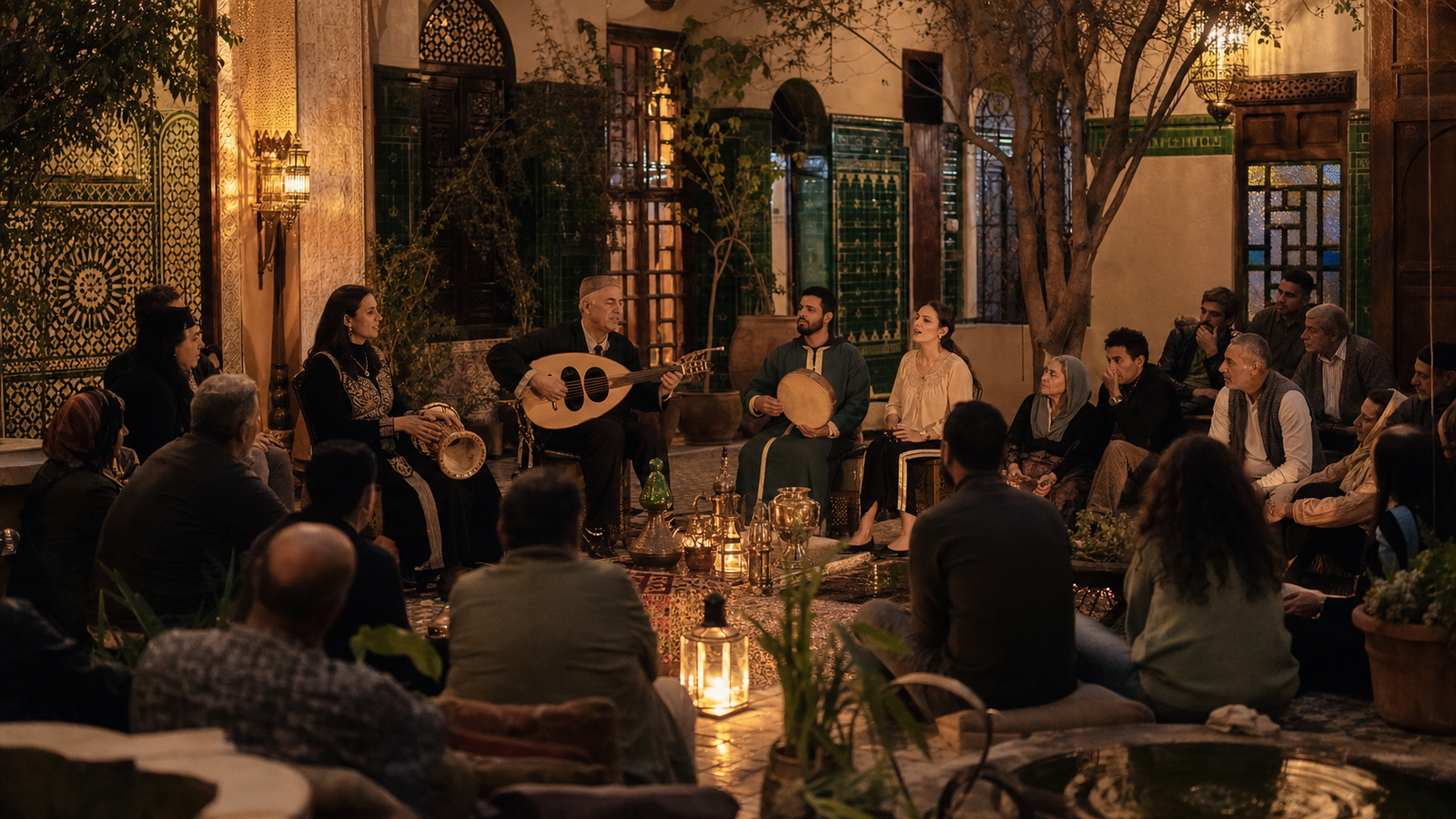
A lead singer carries the text, but the ensemble shapes its emotional scale. Oud, violin, rebab and percussion may support the melodic progression, while choral responses create collective emphasis. The listener is not passive: recognition of a verse, image or cadence changes the energy in the room.
That is why a short online clip can introduce Malhun but cannot fully contain it. The form rewards duration. Meaning accumulates across verses; repetition alters attention; the audience learns where the poem is going.
An archive held by people
Manuscripts and recordings are essential, yet much of the tradition survives through memory and apprenticeship. Performers learn pronunciation, melodic modes, repertory and etiquette from experienced practitioners. Associations and festivals create places to rehearse and transmit that knowledge.
Preservation must include access for young musicians and women, fair documentation of authors and performers, and careful digitisation. An archive that no one can hear or study is only partly alive.
How to listen for the first time
Begin with the text. Find a translation if needed, then notice recurring images and the relation between solo line and ensemble response. Do not ask whether Malhun sounds “modern.” Ask how it manipulates expectation, breath and collective memory. The sophistication becomes audible quickly.
Malhun is sometimes presented as a jewel from the past. Its stronger identity is a technology of presence: a city gathers, a poem enters the voice, and language learns to sing again.
Sources and further reading