Jebel Irhoud and the Long Emergence of Homo sapiens
The Moroccan fossils that pushed the story of our species beyond a single birthplace are often reduced to one number: 315,000 years. The real discovery is more interesting than the headline.
When the Jebel Irhoud research was published in 2017, one phrase travelled faster than the science: “the oldest Homo sapiens.” It was an understandable headline. It was also an incomplete description of what the fossils revealed.
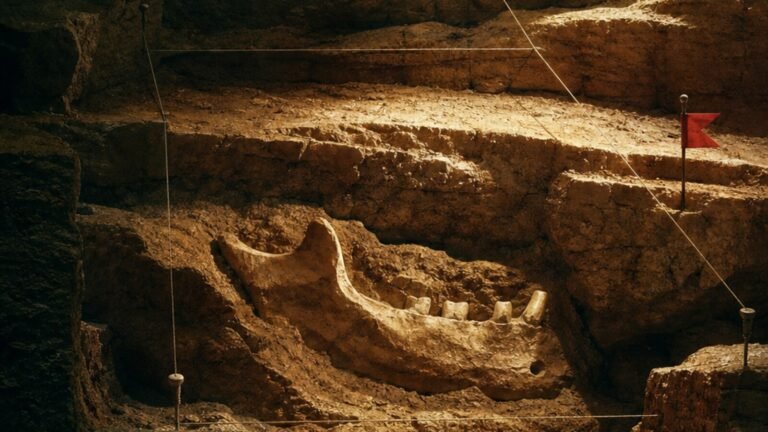
The remains from Jebel Irhoud, about 100 kilometres west of Marrakech, were dated to 315,000 years ago, plus or minus 34,000 years. Their faces, jaws and teeth share important features with later humans. Their braincases retain a longer, more archaic shape.
That mosaic is the point. The people represented at Jebel Irhoud were not simply modern humans placed far back in time. They document an early stage in the development of the Homo sapiens lineage, when different parts of the anatomy were changing at different rates.
A face ahead of its braincase
If one of the Jebel Irhoud individuals stood in a modern crowd, the face might appear surprisingly familiar. The overall facial form is relatively small and tucked beneath the braincase compared with many earlier hominins. The lower jaw and teeth also align the fossils with early or recent modern humans.
The back of the skull tells a different story. Rather than the rounded, globular shape typical of living humans, the braincase is longer and lower. Researchers interpret this as evidence that the modern human face emerged before the fully modern organisation and shape of the braincase.
Evolution did not flip a switch. Traits accumulated through populations over long periods.
Fire, stone and a difficult date
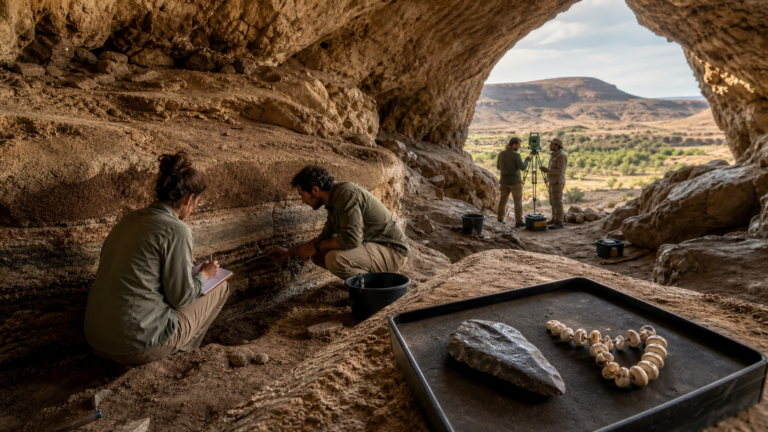
The age estimate came from thermoluminescence dating of heated flint artefacts found in the same archaeological layer. When flint is heated and then buried, energy accumulates in its mineral structure. Measuring the light released under controlled laboratory heating can estimate how much time has passed since that heating event.
The site also produced Middle Stone Age tools and animal remains. This context connects fossils to behaviour without pretending that a stone tool can identify a species on its own.
The research team did not rely on one skull, one date or one visual resemblance. It compared facial, dental, mandibular and braincase morphology across fossil and recent human samples, then interpreted the anatomy alongside the archaeological and chronological evidence.
Beyond a single cradle
Jebel Irhoud weakened an older picture in which modern humans appeared suddenly in one small part of East Africa before spreading elsewhere. The authors argued instead that the evolutionary processes behind Homo sapiens involved the African continent more broadly.
This does not mean every region contributed equally or continuously. Nor can one Moroccan site prove a complete pan-African model by itself. It means the evidence for our species’ emergence is geographically distributed and that north-west Africa belongs inside the main story, not in a footnote.
The discovery of 773,000-year-old hominins at Thomas Quarry I in Casablanca adds a much earlier Moroccan population to that landscape. The sites are separated by hundreds of thousands of years. Their value lies in the long sequence they help reveal, not in forcing them into a simple ancestor-to-descendant chain.
What remains uncertain
Fossils can show anatomical affinities. They cannot reconstruct the exact movements or genetic relationships of every African population living more than 300,000 years ago. The label Homo sapiens is also a scientific classification applied to a changing lineage, not a claim that the Jebel Irhoud people were identical to us.
The careful version of the story is therefore the strongest one: by 315,000 years ago, people in Morocco already carried a significant part of the anatomical pattern associated with our species. Other features continued to evolve. Human origins look less like a single point on a map and more like a continent-wide process of connection, separation and repeated change.
Build the timeline
The Morocco Deep History: Discovery Atlas places Jebel Irhoud alongside other major Moroccan sites with source notes and evidence prompts.
View the atlasPrimary sources
- Hublin, J.-J. et al. “New fossils from Jebel Irhoud, Morocco and the pan-African origin of Homo sapiens.” Nature 546, 289–292 (2017).
- Richter, D. et al. “The age of the hominin fossils from Jebel Irhoud, Morocco, and the origins of the Middle Stone Age.” Nature 546, 293–296 (2017).