What Casablanca Looked Like 773,000 Years Ago
Beneath Morocco’s largest city, a quarry has preserved evidence from a human world far older than our species. The fossils do not offer a tidy “missing link.” They offer something more useful: a securely dated view of a diverse African population near a crucial evolutionary branching point.
Casablanca is usually read at street level: white façades, traffic, Atlantic light and construction. Thomas Quarry I asks us to read downward.
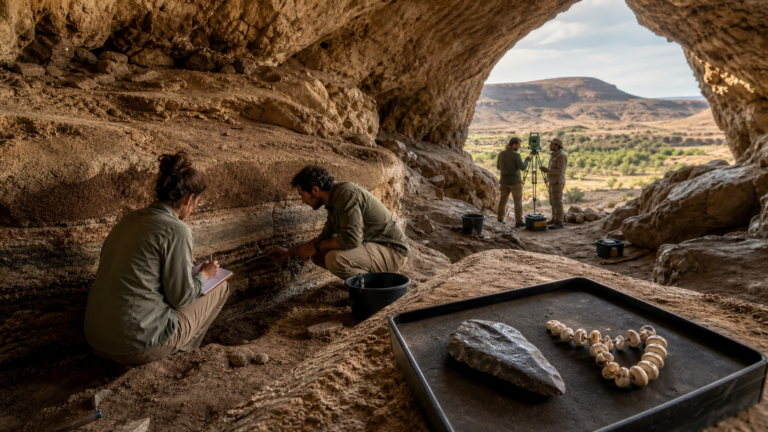
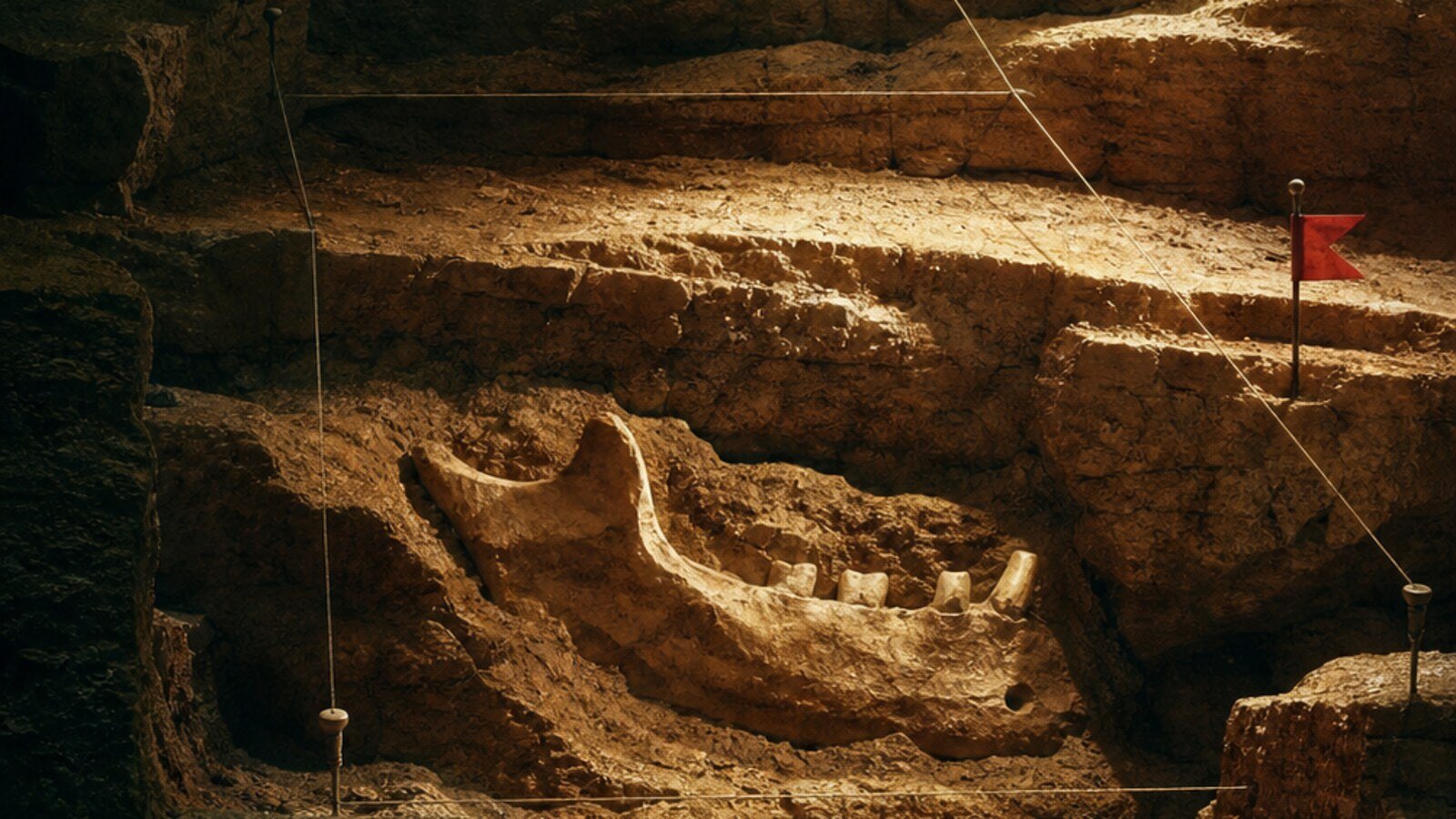
In January 2026, an international team described hominin fossils from the quarry’s Grotte à Hominidés and dated them to about 773,000 years ago. The finds include mandibles, teeth, vertebrae and part of a femur. Their age places them close to the period in which the ancestral populations of present-day humans, Neanderthals and Denisovans were separating.
That does not make the Casablanca individuals the confirmed “last common ancestor.” Evolution rarely leaves evidence that neat. What the fossils show is a distinctive mosaic: primitive traits alongside features reminiscent of later Homo sapiens and archaic Eurasian populations. The researchers interpret them as strong evidence for an African lineage ancestral to our species.
How 773,000 years was established
The date is not a guess based on the appearance of a jaw. It comes from the geological context.
The Grotte à Hominidés sits within the Oulad Hamida Formation. Researchers studied the magnetic polarity recorded in its sediments and placed the fossil-bearing sequence around a major reversal in Earth’s magnetic field. The published nominal age is 773 ± 4 thousand years.
This distinction matters. A dramatic fossil can attract attention, but its scientific value depends on where it was found, how the layers relate to one another and whether the chronology is independently supported.
The object is only part of the evidence. The layer, position, associated fauna, sediments and excavation history complete the record.
A city built above an archive
Thomas Quarry I preserves more than one moment of early human activity. Another locality in the quarry has yielded an extensive early Acheulean stone-tool assemblage dating to roughly 1.3 million years ago.
The quarry landscape also explains the record’s fragility. Extraction exposed deposits that would otherwise have remained hidden, but it disturbed parts of the cave. A mandible found in 1969 lay on a slope below the cavity rather than in an undisturbed layer. Later controlled excavations recovered additional fossils with much stronger spatial and geological documentation.
This is why archaeology is not treasure hunting. Context is what turns an object into evidence.
What the fossils change
The Casablanca material adds a well-dated North African population to a period for which the African fossil record remains thin. It also belongs to a remarkable Moroccan sequence: Thomas Quarry I documents hominins hundreds of thousands of years before the early Homo sapiens fossils at Jebel Irhoud.
The two sites should not be forced into a single straight line. Together, however, they make Morocco central to the question of how our lineage developed across Africa.
The strongest conclusion is not that “humanity began in Casablanca.” The paper does not say that. The stronger, more accurate conclusion is that populations in north-west Africa formed part of the evolutionary landscape from which our species emerged — and that this region can no longer be treated as a blank space.
What remains open
The fossils cannot tell us what these individuals called themselves, how they organised their lives or whether their population contributed directly to later humans. Fossil anatomy can reveal relationships and differences; it cannot turn a complex population history into a family portrait.
Future finds may refine the chronology, add new anatomical evidence or reveal other African populations of similar age. The Casablanca fossils matter precisely because they make the next questions sharper.
Explore the evidence
Morocco Before the Textbooks turns this discovery and three others into a guided archaeology investigation.
Open the digital editionPrimary source
- Mounier, A. et al. “Early hominins from Morocco basal to the Homo sapiens lineage.” Nature 649, 902–908 (2026). DOI: 10.1038/s41586-025-09914-y.