Oued Beht and the Farming Society Missing from Mediterranean History
Thousands of pottery fragments, deep pits, grinding stones, crops and animal bones are forcing archaeologists to reconsider north-west Africa’s place in later prehistory.
Oued Beht does not offer one spectacular royal tomb or a single object made for a museum spotlight. Its power comes from accumulation.
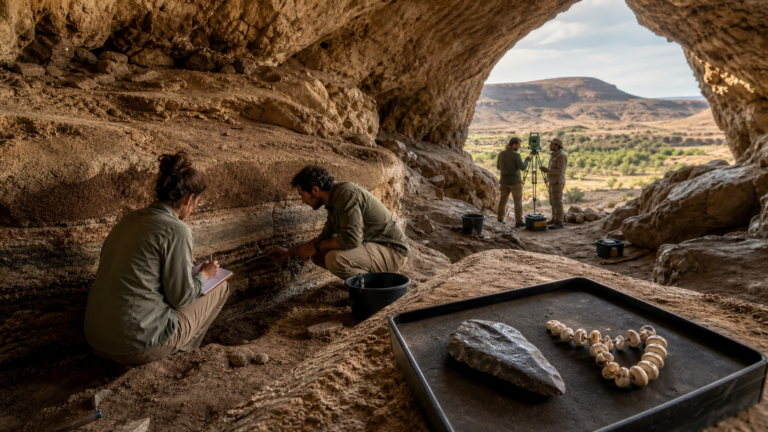
During a systematic 2022 survey, researchers recorded 19,626 finds across 19.5 hectares: 16,258 pottery fragments, 2,947 pieces of chipped stone, 50 axes or adzes and 371 larger stone tools. The densest Final Neolithic activity covers roughly nine to ten hectares.
Radiocarbon dates from charcoal and seeds place the main phase between 3400 and 2900 BC. For at least five centuries, people invested labour and resources in this ridge above the Oued Beht.
A landscape of pits
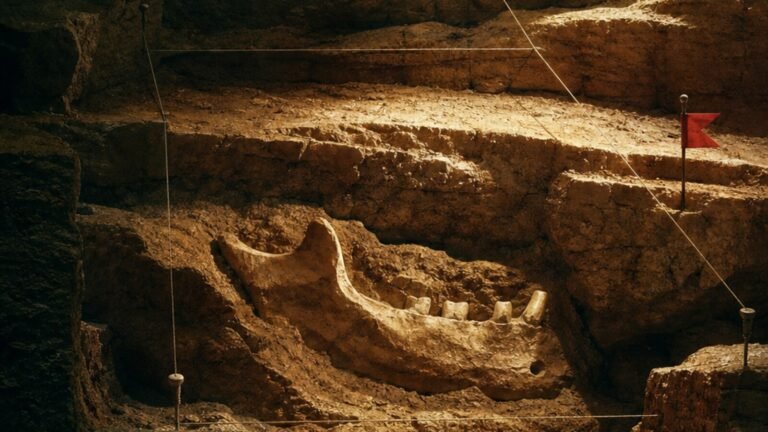
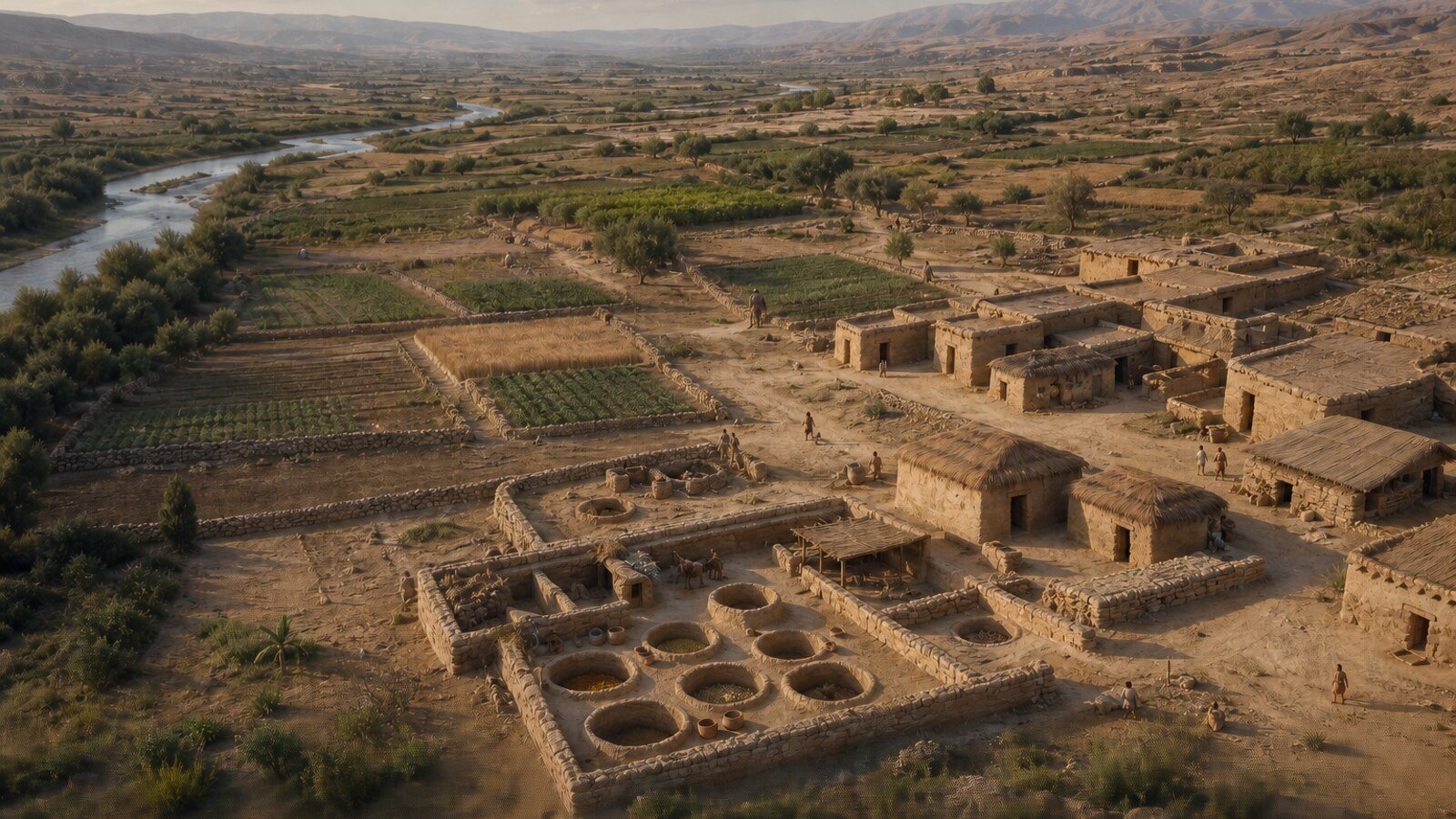
Excavations revealed postholes, activity surfaces, structural daub and numerous deep, bell-shaped pits with narrow mouths. Their form suggests that some may originally have served as storage silos, perhaps for crops. The researchers are careful: the material filling a pit may reflect later disposal rather than its first use.
That distinction is a useful lesson in archaeological reasoning. A pit full of broken pottery and food remains was not necessarily dug as a rubbish hole. Archaeologists compare its shape, location, fill sequence and parallels elsewhere before proposing a function.
If the observed density of roughly one pit per ten square metres extends across the main site, the storage and labour implications would be substantial. Geophysics and further trenching are still needed before that projection becomes a site-wide fact.
What people grew and ate
One excavated pit produced charred naked barley, wheat and pea, along with wild olive and pistachio. Animal remains include domestic goats, sheep, cattle and pigs; cut marks indicate butchery on site. Grinding tools dominate the large stone-tool assemblage, consistent with intensive plant processing.
Together, the evidence points to an economy strongly based on food production. This is not a vague “advanced civilisation” label imposed from the present. It is a community whose daily work left measurable traces: seeds, bones, pottery, grinding surfaces, tool-making debris and architecture.
Painted pottery and local skill
The site produced large quantities of pottery, including a smaller but important group of dark-on-light painted sherds. The researchers describe the technical skill as striking in relation to other early Maghrebian pottery.
Parallels exist in north-west Morocco and southern Iberia, but similarity does not prove that ideas moved in only one direction. Oued Beht’s painted pottery appears plausibly local, and the site also yielded evidence for on-site production of axes and adzes.
Western Mediterranean prehistory has often been narrated from the European shore. Oued Beht makes north-west African agency impossible to ignore.
Village, aggregation site, or something else?
Calling Oued Beht a large village is tempting. It may eventually be correct. The scale, pits, grinding stones, crops, domestic animals and pottery all support the possibility of a substantial settled community.
The research team stops short of declaring the case closed. The exact nature of above-ground structures remains uncertain. Some pits may have changed function. Human remains reported in the past require further investigation. Social organisation cannot be read directly from site size.
This caution strengthens the story. Oued Beht is already exceptional without turning it into a lost city or an “African Troy.” It documents an established farming society in the late fourth millennium BC and a complex community connected to, but not explained away by, the wider Mediterranean world.
A map with two shores
The Strait of Gibraltar is often drawn as a boundary. In later prehistory it was also a corridor. Pottery traditions, raw materials, animals and technologies raise questions about connections between Morocco and Iberia.
The researchers argue for a co-evolving framework that recognises movement in more than one direction. Oued Beht was an African-based community with its own production, choices and history. Its importance lies not in making Morocco a mirror of Europe, but in showing that both shores helped shape the western Mediterranean.
Investigate the claim
Morocco Before the Textbooks includes an Oued Beht dossier that asks readers to distinguish excavation evidence from larger historical interpretations.
Open the investigationPrimary source
- Broodbank, C. et al. “Oued Beht, Morocco: a complex early farming society in north-west Africa.” Antiquity 98 (401), 1199–1218 (2024). DOI: 10.15184/aqy.2024.101.