Five Moroccan Sites That Changed the Human Story
For a long time, popular accounts of human origins treated North Africa like a corridor between more important places. Morocco’s caves, quarries and ancient shorelines now tell a different story. They preserve people, tools, ornaments and footprints across hundreds of thousands of years—evidence that repeatedly changes the questions scientists ask about who we became.
These five sites do not form a neat march of progress. They are windows separated by enormous spans of time. Together, they show why Morocco is one of the essential laboratories of human prehistory.
1. Casablanca: a human presence close to 800,000 years ago
Research published in Nature in 2026 reported hominin remains and associated evidence from the Casablanca area dated to roughly 773,000 years ago. The finding matters because secure dates are rare at this depth of time in north-west Africa. The Atlantic edge of Morocco was not a blank space awaiting later arrivals; it was part of the world inhabited by early humans.
The fossils do not permit a simple claim that one named population “became” us. Their value lies in the combination of anatomy, geology and chronology. They sharpen the record at a period when populations in Africa and Eurasia were diversifying.
2. Jebel Irhoud: the face of early Homo sapiens
Jebel Irhoud, west of Marrakech, produced fossils dated to about 315,000 years ago. The faces are strikingly modern while the braincases retain more archaic proportions. Stone tools and burned flint helped establish the age of the deposits.
The discovery weakened the old idea that our species appeared suddenly in one small East African “cradle.” A better model sees early Homo sapiens traits developing across connected African populations. Morocco is not peripheral to that model; it is one of its strongest pieces of evidence.
3. Bizmoune Cave: shell beads older than 140,000 years
At Bizmoune Cave near Essaouira, archaeologists recovered perforated marine shells dated to approximately 142,000–150,000 years ago. Thirty-two or thirty-three specimens were reported. Wear and modification indicate that people selected and used them as ornaments.
A bead is small, but the behaviour behind it is large. Ornamentation can signal identity, affiliation or status. It turns a body into a social message. The Bizmoune finds push that symbolic practice deep into the Middle Stone Age.
4. Contrebandiers Cave: a technology for clothing
Bone tools from Contrebandiers Cave near Temara, dated mainly between 120,000 and 90,000 years ago, include implements interpreted as tools for working hides and fur. The evidence suggests a specialised chaîne opératoire rather than casual bone use.
Clothing rarely survives archaeologically. Tools can preserve its shadow. Tailored or prepared skins would have offered protection and may also have carried social meaning. The cave therefore links technical skill to the ways humans adapted and presented themselves.
5. Larache: a family-sized trail on an ancient beach
At a rocky beach near Larache, researchers documented 85 human footprints left around 90,000 years ago. The tracks were made by several individuals, including children, adolescents and adults, crossing a coastal surface before sediment protected their impressions.
Fossils often reduce a person to a fragment. Footprints restore movement. They reveal direction, pace, body size and a group sharing one moment. The Larache trail is scientifically valuable and emotionally immediate: people walked here, together, beside the Atlantic.
What discovery really looks like
None of these conclusions came from an isolated spectacular object. Dates were built from sediment, heated flint, uranium-series measurements or luminescence. Interpretations were tested against anatomy, use-wear and experimental comparison. New work can refine them.
That is the grandeur of Moroccan archaeology. It does not need invented mysteries. Its real evidence is more astonishing: across immense time, this landscape preserves repeated experiments in survival, technology, identity and community.
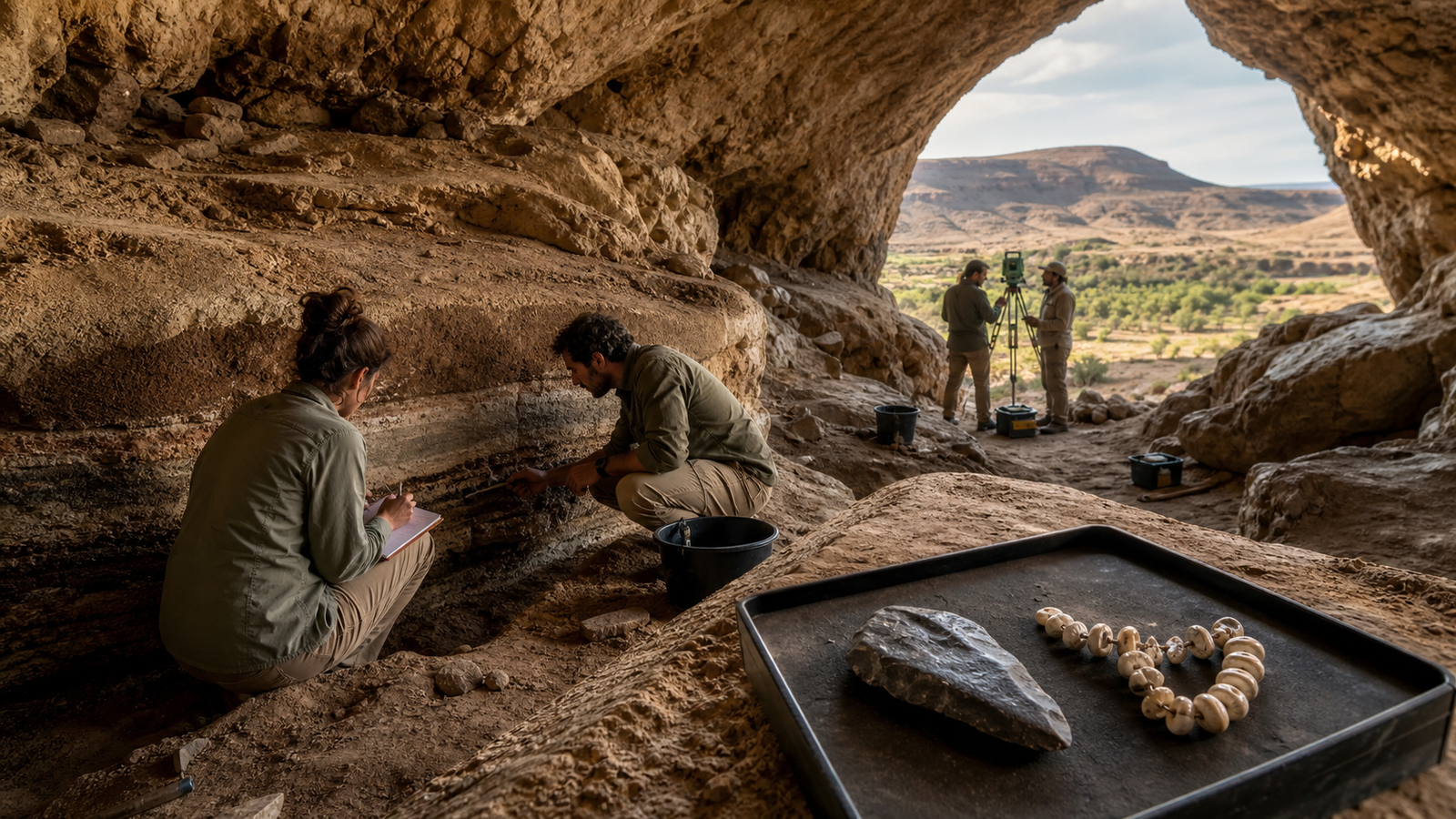
The featured image is an editorial illustration created for MoroccoNation, not a photograph of any one excavation or artifact assemblage.
Sources and further reading
- Nature — Early Pleistocene hominins from Casablanca
- Nature — New fossils from Jebel Irhoud
- Nature — Age of the Jebel Irhoud fossils
- Moroccan Ministry of Culture — Bizmoune shell ornaments
- iScience — Bone tools and clothing at Contrebandiers Cave
- Scientific Reports — Late Pleistocene footprints at Larache