Hicham El Guerrouj and the Double That Took Eight Years
Hicham El Guerrouj arrived in Athens as the greatest 1500-metre runner of his era and a man still missing the Olympic title that defined public judgment. Four days later, he left with two gold medals and a double no man had completed since Paavo Nurmi in 1924.
The clean ending can make the journey look inevitable. It was not.
Atlanta: the fall
At the 1996 Olympic final, the 21-year-old El Guerrouj was moving behind Algeria’s Noureddine Morceli when contact disrupted his stride. He fell with just over a lap remaining and finished last. The image became a wound he would carry into every Olympic conversation.
Sydney: excellence meets one rival
Between Games, El Guerrouj dominated the middle distances and set world records. At Sydney 2000, however, Kenya’s Noah Ngeny beat him in the final. Silver was an extraordinary achievement judged against any normal career. Against El Guerrouj’s standard, it felt like a second postponement.
Athens: first the 1500
In 2004, even certainty had begun to crack. El Guerrouj lost races before the Games, including to Bernard Lagat. The Olympic final became a long sprint of tactical patience. Down the straight, Lagat drew alongside. El Guerrouj found one final response and won by twelve hundredths of a second.
His collapse after the line communicated more than celebration. Eight years of Olympic frustration had been converted into a result.
Then the 5000
Four days later, El Guerrouj faced athletes whose natural territory was twelve and a half laps. Ethiopia’s Kenenisa Bekele, already the 10,000m champion, was the defining rival. The race came down to speed. El Guerrouj used the finishing power developed over 1500 metres and held off Bekele to win.
The double linked two different competitive problems: positioning and acceleration in the 1500; endurance and restraint in the 5000. Only Nurmi had previously won both at the same Olympic Games.
The records still standing
El Guerrouj’s world records for 1500 metres (3:26.00) and the mile (3:43.13), both set in 1998 and 1999 respectively, remain benchmarks. Yet Athens may be his more human achievement. A record suggests mastery. The Olympic double includes failure, adjustment, doubt and recovery.
That is why the story took eight years. Not because El Guerrouj needed eight years to become great, but because greatness did not protect him from losing—and he returned anyway.
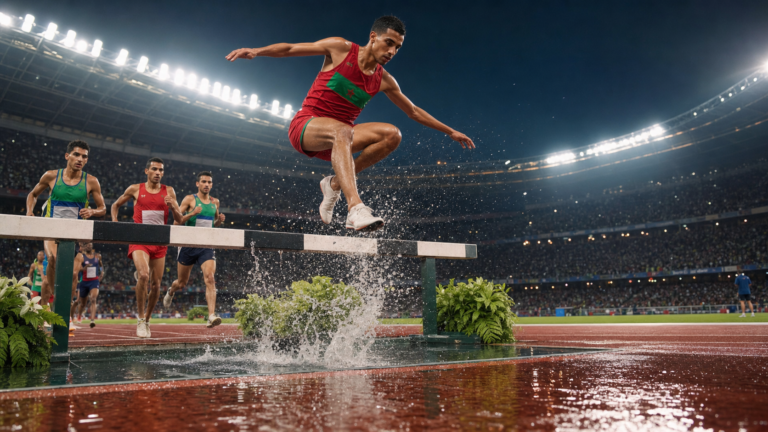
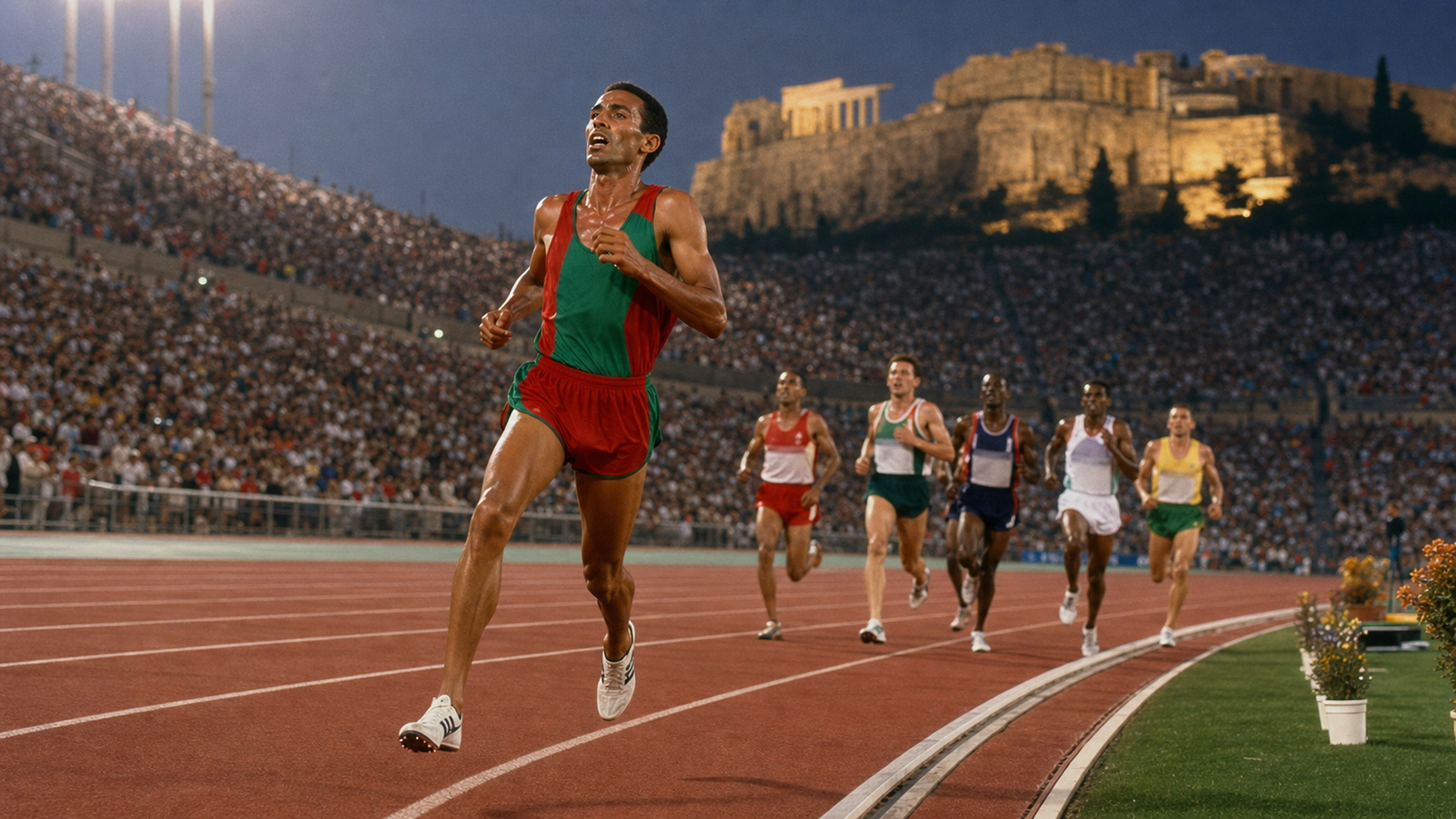
The featured image is an AI-created editorial reconstruction, not an archival photograph.
Sources and further reading