Morocco’s 2026 Throne Day Address: The Growth Story — and Its Delivery Test
King Mohammed VI presented stability, industry and sovereignty as the foundations of Morocco’s next growth cycle. The harder test is whether finance and development reach smaller firms and every region.
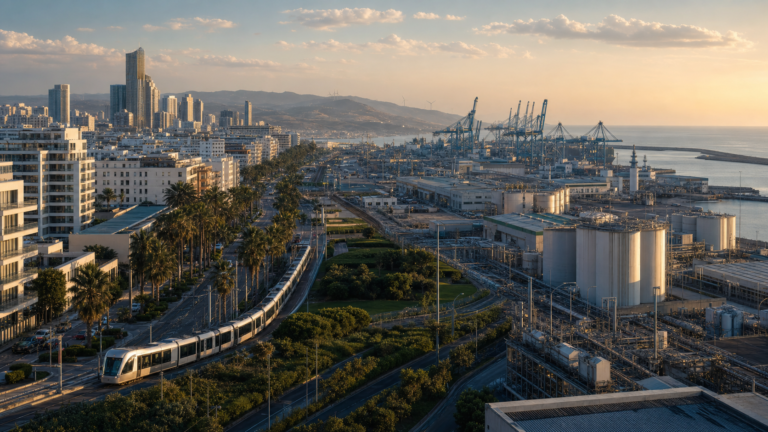
Morocco’s 2026 Throne Day address was built around a clear proposition: political stability has given the country time to construct industrial capacity, strengthen strategic autonomy and attract investment. The next phase, however, will be judged less by the scale of national projects than by their reach.
That distinction matters. The speech was confident about Morocco’s direction, but its most consequential passages concerned the difficult machinery of development: local implementation, domestic financing and access to capital for smaller businesses.
A national strategy built on stability
King Mohammed VI described security, institutional continuity and the ability of the state to act as strategic economic assets. In a period marked by protectionism, unstable supply chains and regional upheaval, Morocco’s proposition is that predictability allows it to plan further ahead than many competitors.
The address also referred to the response to floods in western and northern regions as an example of crisis management. In this reading, resilience is not separate from economic policy. Families cannot plan, companies cannot invest and supply chains cannot operate when institutions fail under pressure.
The speech’s argument can therefore be summarized without ceremony: stability creates room for investment; investment builds productive capacity; productive capacity should reinforce sovereignty and employment. Each link is plausible. None is automatic.
The economic scorecard
The King cited growth of approximately 4.9% in 2025 and said a similar or higher rate was expected in 2026. The High Commission for Planning separately forecasts 5.0% growth for 2026. Better rainfall was associated with a stronger agricultural season and improved water and food security. Tourism, meanwhile, reached nearly 20 million arrivals in 2025, including Moroccans living abroad.
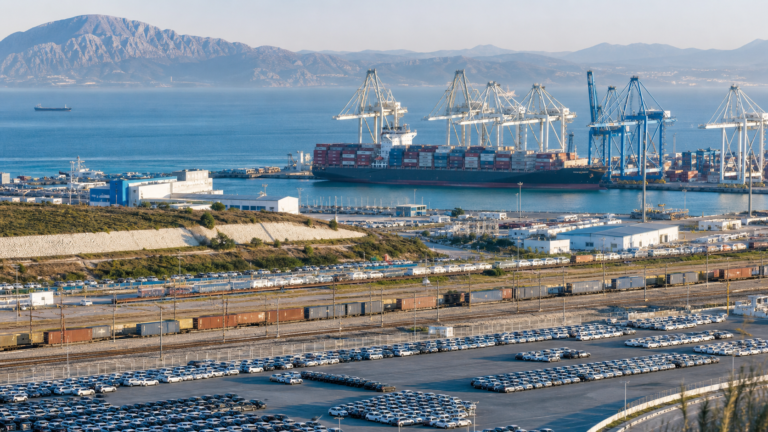
Industry received the greatest attention. The address described automotive, aviation, renewable energy and food processing as pillars of production, investment and job creation. Morocco now has capacity to produce nearly one million cars annually and was presented as Africa’s leading vehicle exporter.
Automotive and aviation exports together were said to exceed 40% of Morocco’s total exports, ahead of phosphates. A MoroccoNation calculation using official first-quarter 2026 trade values places the combined share at approximately 41.4% for that period; it is not an annual figure.
The MWN transcription also associates food and pharmaceutical industries with around 80% coverage of national needs. Official material independently located for this analysis confirms the 80% rate for pharmaceuticals, but not for the two sectors combined. The syntax must be checked against the official Arabic or French speech when it is archived.
These are significant claims, but they should be read carefully. Figures used in a national address summarize a broad economic direction. Serious evaluation still requires definitions, reporting periods and the underlying official statistical series.
From assembly to strategic industry
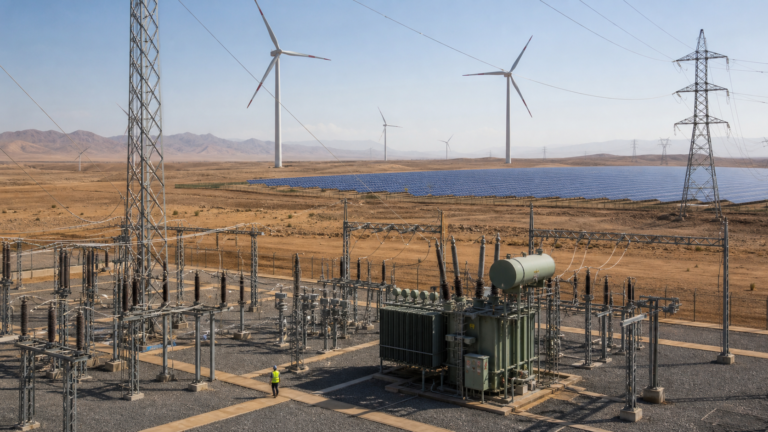
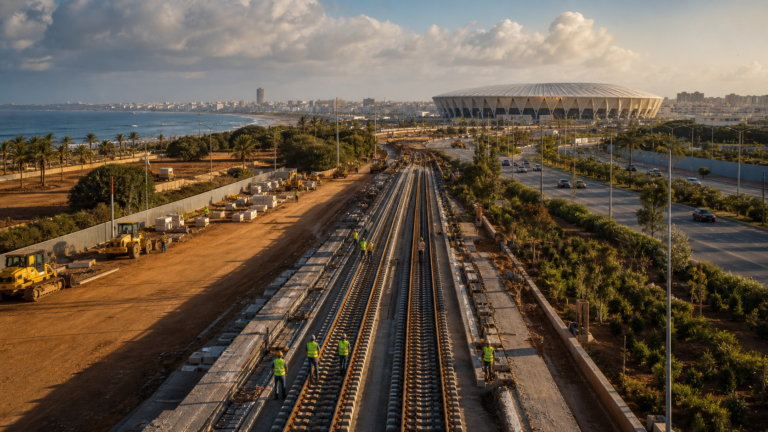
The most forward-looking section concerned the complexity of what Morocco wants to produce. New aircraft-engine and landing-gear factories, an integrated electric-battery sector and renewable energy for low-carbon industry were presented as signs of technological progression.
The speech also referred to an initial group of projects under the Morocco Offer for green hydrogen. Official background material places those projects at preliminary land-reservation and advanced-development stages, not at final construction. Batteries, low-carbon electricity and hydrogen together point to a larger ambition: anchoring new manufacturing chains in Morocco before global industrial geography settles around them.
Defense industry and cybersecurity were added to this sovereignty agenda. That creates possible demand for engineering, software, components, maintenance, logistics, research and technical training. Yet an expanding sector does not guarantee that local firms automatically enter its supply chain. Standards, procurement, skills and finance decide who participates.
What this could mean for Moroccans
For citizens, the most useful opportunities are not abstract export records. They are the jobs, contracts, skills and services that can grow around productive investment.
A young engineer may find a route into aviation, batteries or cybersecurity. A transport or maintenance company may serve a new factory. A cooperative may benefit from stronger food-processing capacity. A founder may build software for logistics, energy management or export compliance.
But the speech did not announce an individual entitlement to any of these opportunities. It did not specify a new application window, lending rate or universal subsidy. Turning national strategy into accessible opportunity requires training, transparent procurement and institutions capable of guiding smaller participants through complex systems.
The passage that smaller businesses should watch
The King said Morocco’s economic and social transformation would require unprecedented financial resources, most of them mobilized domestically. He called on the financial sector to expand bank and non-bank financing for small and medium enterprises, innovation, manufacturing and exports.
He also urged greater mobilization of national savings and stronger financial markets. This is not a minor technical point. Large projects can be financed through state institutions, major banks or international partnerships. A smaller business often faces a different reality: collateral requirements, short maturities, limited risk appetite and little help preparing an investable project.
The measure of progress will not be how many financing vehicles exist on paper. It will be whether viable companies can obtain capital suited to buying equipment, hiring skilled staff, meeting certification requirements and surviving the delay between an order and payment.
The territorial test
The speech called for integrated local development programs to be implemented effectively in every region without exception. It did not publish a list of failing regions, but the instruction itself points to the challenge: national success can coexist with unequal local experience.
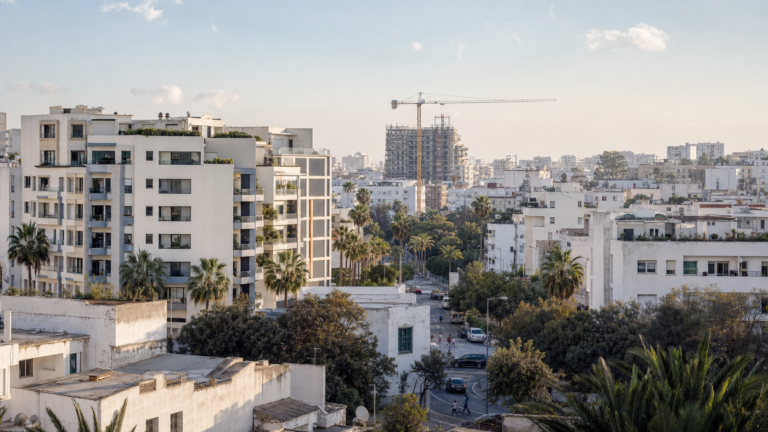
A factory cluster, port or airport may lift national indicators while a smaller city still lacks the skills pipeline, business services or transport connection required to benefit. Social protection may be universal in design while access remains difficult in practice.
The next development cycle will therefore need a visible local scorecard. Which institution owns the deadline? Which budget is committed? Which service has improved? Which firms and households can now do something they could not do before?
The diaspora: an opening, not a new program
Moroccans abroad were included in the tourism figure, but the address did not set out a dedicated diaspora program. It would be inaccurate to transform that reference into a promise.
The broader strategy nevertheless creates possible openings. Diaspora engineers and researchers can connect Moroccan institutions to international expertise. Founders can build across two markets. Investors can bring both capital and commercial networks. Return does not have to mean a permanent relocation; it can take the form of mentoring, procurement, research, co-investment or export development.
For this potential to become real, procedures must be understandable and rules must apply equally. The diaspora is most valuable not simply as a source of remittances, but as a bridge of knowledge, trust and market access.
For African and international partners
The King described Morocco as a reliable and sought-after international partner pursuing balanced and diversified relationships. The speech did not announce a specific African investment package, but it did place Morocco’s industrial rise in a regional context, notably through its position in automotive exports.
For African partners, potential cooperation can emerge in manufacturing, finance, energy, logistics and training. For investors from elsewhere, Morocco offers industrial ecosystems, access to Atlantic and Mediterranean routes and proximity to both European and African markets.
These are strategic advantages, not guarantees of commercial success. Each project still has to test energy availability, land, water, skills, regulation, financing, suppliers and actual market demand. Good partnership should also create local capability instead of leaving only a physical asset behind.
The warnings inside a confident speech
The address did not dwell on failure, but it identified constraints through the solutions it demanded.
- External volatility: protectionism and insecure supply chains make national production more valuable but also raise costs and uncertainty.
- Climate and disaster exposure: rainfall can strengthen agriculture, while floods and water pressure can rapidly reverse gains.
- Uneven delivery: the insistence on covering every region indicates that territorial reach remains a test.
- The financing gap: the call for broader SME finance suggests that productive smaller firms still need better access to suitable capital.
- Execution risk: industrial capacity is not the same thing as broadly shared prosperity.
These are not reasons to dismiss Morocco’s progress. They are the standards by which the next phase should be judged.
A new cycle after the elections
Following the legislative elections and the formation of a new government, the King said he expected a new development cycle to consolidate previous gains and continue major reforms and projects.
The most useful reading of the 2026 address is therefore neither triumphal nor cynical. Morocco has accumulated real industrial capacity and international credibility. The next challenge is to distribute the benefits through skills, finance, local services and opportunity beyond the strongest corridors.
Watch the budgets. Watch access to SME finance. Watch implementation in the regions. That is where the speech’s meaning will become measurable.
Sources
- Morocco World News — English transcription of the 27th Throne Day address, published 29 July 2026.
- Maroc.ma — Royal Speeches archive, checked 30 July 2026; the 2026 transcript was not yet listed at the time of production.
- Royal Cabinet communique of 4 November 2025, confirming Throne Day as an official occasion for a royal speech.
- High Commission for Planning — economic accounts and forecasts, supporting 4.9% growth in 2025 and a 5.0% forecast for 2026.
- Official first-quarter 2026 export figures, used for MoroccoNation’s period-specific automotive and aerospace calculation.
- Official green-hydrogen project-status notice, clarifying the preliminary land-reservation stage.
- Official notice on the TPE financing and support charter.